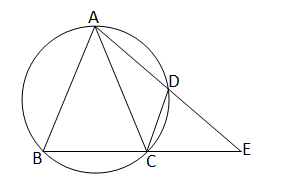
Let triangle ∆ABC be such that AB = AC, and let E be a point on the extension of BC. The circumcircle of triangle ABC intersects line AE at point D. We are to prove that: \[ \angle ACD = \angle AEC \] **Construction:** Join points C and D. **Proof:** In cyclic quadrilateral ABCD, \[ \angle ABC + \angle ADC = 180^\circ \quad \text{(opposite angles)} \] Also, since D lies on line AE and CD is drawn, \[ \angle CDE + \angle ADC = 180^\circ \] So, \[ \angle ABC + \angle ADC = \angle CDE + \angle ADC \Rightarrow \angle ABC = \angle CDE \quad \text{---(i)} \] Now, since AB = AC in triangle ABC, \[ \angle ABC = \angle ACB \quad \text{---(ii)} \] In triangle CDE, extend EC up to point B. Then, \[ \angle DCB = \angle CDE + \angle DEC \Rightarrow \angle ACD + \angle ACB = \angle CDE + \angle DEC \Rightarrow \angle ACD + \angle ACB = \angle ABC + \angle DEC \quad \text{[using (i)]} \Rightarrow \angle ACD + \angle ACB = \angle ACB + \angle DEC \quad \text{[using (ii)]} \Rightarrow \angle ACD = \angle DEC \] Therefore, \[ \angle ACD = \angle AEC \quad \text{(proved)} \]