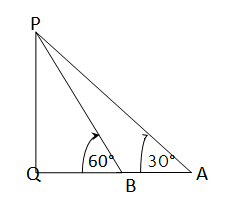
Let’s assume that from point A on the ground, the angle of elevation to the top P of a vertical pillar PQ is \(\angle\)PAQ = 30°. After moving 20 meters toward the base of the pillar and reaching point B, the angle of elevation becomes \(\angle\)PBQ = 60°. From right-angled triangle PAQ: \[ \tan 30^\circ = \frac{PQ}{QA} \Rightarrow \frac{1}{\sqrt{3}} = \frac{PQ}{QA} \Rightarrow QA = \sqrt{3} \cdot PQ \] From right-angled triangle PBQ: \[ \tan 60^\circ = \frac{PQ}{QB} \Rightarrow \sqrt{3} = \frac{PQ}{QB} \Rightarrow QB = \frac{PQ}{\sqrt{3}} \] Now, \[ QA - QB = AB = 20 \Rightarrow \sqrt{3}PQ - \frac{PQ}{\sqrt{3}} = 20 \Rightarrow PQ\left(\sqrt{3} - \frac{1}{\sqrt{3}}\right) = 20 \Rightarrow PQ\left(\frac{3 - 1}{\sqrt{3}}\right) = 20 \Rightarrow PQ = 20 \cdot \frac{\sqrt{3}}{2} = 10\sqrt{3} \] \(\therefore\) Height of the pillar = PQ = \(10\sqrt{3}\) meters Distance from point A to the pillar = QA = \(\sqrt{3} \cdot PQ = \sqrt{3} \cdot 10\sqrt{3} = 30\) meters.