Answer: B
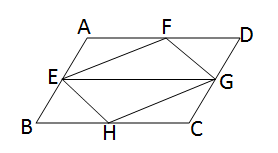
Let’s assume that when the midpoints of the sides of parallelogram ABCD are joined, a quadrilateral EFGH is formed. Join points E and G. E and G are the midpoints of AB and CD respectively. \(\therefore\) EG \(\parallel\) AD \(\therefore\) Parallelogram AEGD = 2 × \(\triangle\)EFG Similarly, Parallelogram ABCG = 2 × \(\triangle\)EHG \(\therefore\) Parallelogram AEGD + Parallelogram ABCG = 2 × \(\triangle\)EFG + 2 × \(\triangle\)EHG = 2 × [\(\triangle\)EFG + \(\triangle\)EHG] That is, Parallelogram ABCD = 2 × Quadrilateral EFGH = 2 × 100 sq cm = 200 sq cm
Let’s assume that when the midpoints of the sides of parallelogram ABCD are joined, a quadrilateral EFGH is formed. Join points E and G. E and G are the midpoints of AB and CD respectively. \(\therefore\) EG \(\parallel\) AD \(\therefore\) Parallelogram AEGD = 2 × \(\triangle\)EFG Similarly, Parallelogram ABCG = 2 × \(\triangle\)EHG \(\therefore\) Parallelogram AEGD + Parallelogram ABCG = 2 × \(\triangle\)EFG + 2 × \(\triangle\)EHG = 2 × [\(\triangle\)EFG + \(\triangle\)EHG] That is, Parallelogram ABCD = 2 × Quadrilateral EFGH = 2 × 100 sq cm = 200 sq cm