1. Draw a right-angled triangle whose two sides adjacent to the right angle are 4.5 cm and 6 cm. Then draw the incircle of that triangle. (Only construction marks are required.)
2. Draw a right-angled triangle whose two sides adjacent to the right angle are 7 cm and 9 cm respectively. Then draw the incircle of that triangle. (Only construction marks are required.)
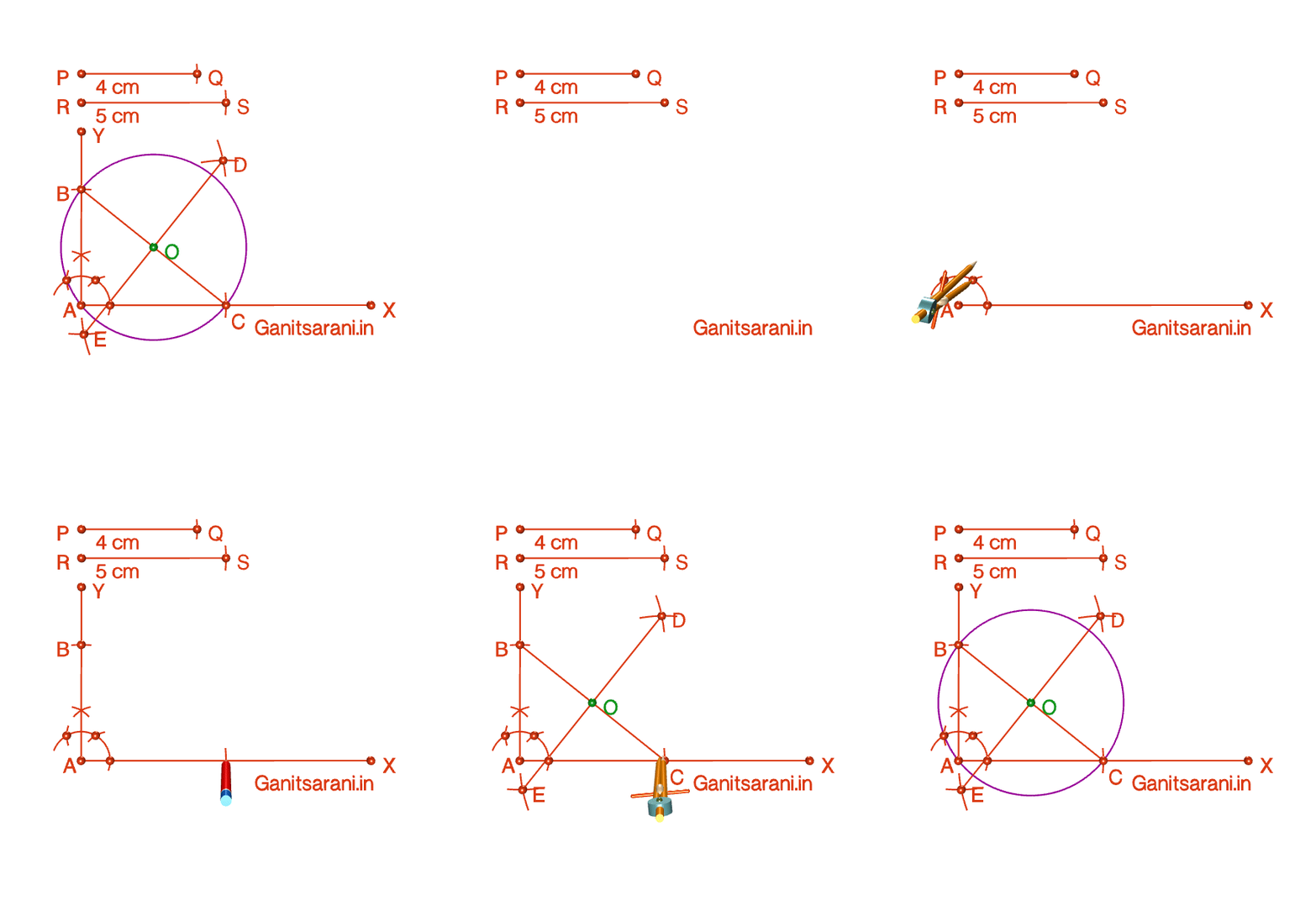
3. A right-angled triangle where the two sides adjacent to the right angle are 4 cm and 4 cm. — Draw the triangle and then draw its circumcircle. Mark the position of the circumcenter and measure and write the radius of the circumcircle. [Only drawing symbols required]
4. Draw a right-angled triangle where the two sides adjacent to the right angle are 5 cm and 6 cm. Then, draw an incircle (a circle inscribed inside the triangle) within that triangle.
5. Draw a right-angled triangle in which the two sides adjacent to the right angle are 5 cm and 6 cm. Then draw a square that has the same area as that triangle.
6. Draw a right-angled triangle whose two sides adjacent to the right angle are 8 cm and 6 cm respectively, and draw an incircle of the triangle. (Only construction marks are required)
7. Draw a right-angled triangle with the two sides adjacent to the right angle measuring 4 cm each. Then draw the circumcircle of the triangle. (Only construction marks are required.)
8. Amina has drawn a right-angled triangle with the two sides adjacent to the right angle measuring 15 cm and 20 cm. When the triangle is revolved once completely around the 15 cm side as the axis, it forms a solid. Calculate the lateral surface area, the total surface area, and the volume of the solid formed.
9. Draw a right-angled triangle whose hypotenuse is 10 cm and one of the other sides is 6.5 cm. Then, draw the incircle of this triangle. (Only construction marks are required.)
10. Draw a right-angled triangle whose hypotenuse is 9 cm and one of the other sides is 5.5 cm. Then draw an incircle of the triangle. (Only the construction marks are required.)
11. Construct a right-angled triangle in which the two arms adjacent to the right angle are 7 cm and 9 cm. Draw an incircle (inscribed circle) of that triangle and measure its radius. (Each construction step must be marked.)
12. A right-angled triangle in which the two sides adjacent to the right angle are 7 cm and 9 cm. — Draw the triangle and then draw its incircle. Measure and write the length of the inradius (i.e., the radius of the incircle).
13. In a right-angled triangle, the lengths of the two sides adjacent to the right angle are 4 cm and 3 cm. If the triangle is rotated once completely about the longer of these two sides as the axis, the solid formed is a cone. Calculate and write the lateral surface area, total surface area, and volume of the cone formed.
14. A right-angled triangle has two sides adjacent to the right angle measuring 4 cm and 3 cm. If the triangle is rotated once completely around its hypotenuse as the axis, find the volume of the solid formed.
15. In a right-angled triangle, the lengths of the two sides adjacent to the right angle are 4 cm and 3 cm respectively. If the triangle is rotated once completely around the longer of the two adjacent sides, find the total surface area and the volume of the solid formed.
16. Prove that if a perpendicular is drawn from the right angle vertex of a right-angled triangle to the hypotenuse, then the two adjacent triangles formed are similar to each other and each is also similar to the original triangle.
17. Prove that if a perpendicular is drawn from the right-angled vertex of a right-angled triangle to the hypotenuse, then the two triangles formed on either side of this perpendicular are similar, and each of these triangles is similar to the original triangle.
18. Prove that if a perpendicular is drawn from the right-angled vertex of any right-angled triangle to the hypotenuse, then the two resulting triangles on either side of the perpendicular are similar to each other and each is also similar to the original triangle.
19. Prove that if a perpendicular is drawn from the right-angled vertex of a right-angled triangle to the hypotenuse, then the two triangles formed on either side of this perpendicular are similar to each other and each is similar to the original triangle.
20. A right-angled triangle where the hypotenuse is 12 cm and one of the other sides is 5 cm. — Draw the triangle and then draw its circumcircle. Mark the position of the circumcenter and measure and write the radius of the circumcircle. [Only drawing symbols required]
21. In a right-angled triangle, the hypotenuse is 6 cm longer than one of the other two sides and 12 cm longer than the other. Find the area of the triangle.
22. ABC is a right-angled triangle with hypotenuse BC. From point A, a perpendicular AD is drawn to BC. If BD = 4 cm and DC = 5 cm, then what is the length of AB?
23. Find the radius of the circumcircle of a triangle whose sides are 3 cm, 4 cm, and 5 cm.
24. In a right-angled triangle, the hypotenuse is 15 cm, and the difference between the other two sides is 3 cm. Find the lengths of those two sides.
25. Draw a right-angled triangle where the two arms adjacent to the right angle measure 7 cm and 9 cm. Then, draw an incircle within the triangle (only the construction marks).
26. Draw a right-angled triangle with its adjacent sides measuring 7 cm and 9 cm. Then, draw an incircle for the triangle. (Provide only the construction steps.)
27. Prove that the area of the square drawn on the hypotenuse of a right-angled triangle is equal to the sum of the areas of the squares drawn on the other two sides.
28. The length of one side is 6.2 cm, and the measures of the two angles adjacent to that side are 50° and 75°. — Draw the triangle and then draw its incircle. Measure and write the length of the inradius (i.e., the radius of the incircle).
29. A right-angled triangle in which the hypotenuse is 9 cm and one of the other sides is 5.5 cm. — Draw the triangle and then draw its incircle. Measure and write the length of the inradius (i.e., the radius of the incircle).
30. If a perpendicular is drawn from the right-angled vertex of any right triangle to the hypotenuse, then the two triangles formed on either side of this perpendicular are similar to each other, and each of them is also similar to the original triangle.