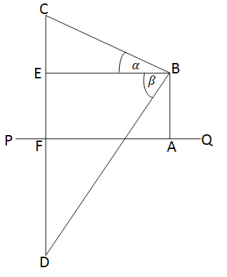
Let \(PQ\) be the lake surface. From point \(A\), located \(h\) meters above the lake, a cloud at point \(C\) is observed from point \(B\) with an angle of elevation \(\angle EBC = \alpha\), and its reflection at point \(D\) on the lake is seen with an angle of depression \(\angle EBD = β\). The distance from the observation point to the cloud is \(BC\). From triangle \(BEC\), \[ \frac{CE}{BE} = \tan \alpha \Rightarrow CE = BE \cdot \tan \alpha \quad \text{(i)} \] From triangle \(BDE\), \[ \frac{DE}{BE} = \tan β \Rightarrow DE = BE \cdot \tan β \Rightarrow DF + EF = BE \cdot \tan β \] Since the height of the cloud above the lake equals the distance of its reflection below the lake surface, \[ \therefore DF = CF \text{and} \quad EF = AB = h \text{ meters} \] \[ \therefore CF + h = BE \cdot \tan β \Rightarrow CE + EF + h = BE \cdot \tan β \Rightarrow CE + h + h = BE \cdot \tan β \Rightarrow CE + 2h = BE \cdot \tan β \] Substituting the value of \(CE\) from (i), \[ BE \cdot \tan \alpha + 2h = BE \cdot \tan β \Rightarrow 2h = BE (\tan β - \tan \alpha) \Rightarrow BE = \frac{2h}{\tan β - \tan \alpha} \quad \text{(ii)} \] Now, from triangle \(BEC\), \[ \frac{BC}{BE} = \sec \alpha \Rightarrow BC = BE \cdot \sec \alpha \] Substituting the value of \(BE\) from (ii), \[ BC = \frac{2h \cdot \sec \alpha}{\tan β - \tan \alpha} \quad \text{(Proved)} \]