Pythagoras' Theorem: In any right-angled triangle, the area of the square drawn on the hypotenuse is equal to the sum of the areas of the squares drawn on the other two sides.
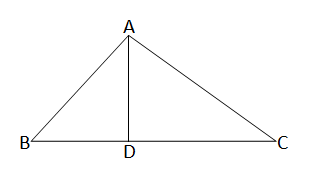
Given: ABC is a right-angled triangle with ∠A as the right angle.
To prove: \(BC^2 = AB^2 + AC^2\)
Construction: Draw a perpendicular AD from the right-angled vertex A to the hypotenuse BC, which intersects BC at point D.
Proof: Since AD is perpendicular to BC in the right-angled triangle ABC,
∴ ΔABD and ΔCBA are similar.
Thus, \(\frac{AB}{BC} = \frac{BD}{AB}\)
∴ \(AB^2 = BC.BD\) \(....(i)\)
Similarly, ΔCAD and ΔCBA are similar.
Thus, \(\frac{AC}{BC} = \frac{DC}{AC}\) \(....(ii)\)
Adding \((i)\) and \((ii)\), we get:
\(AB^2 + AC^2 = BC.BD + BC.DC\)
= BC (BD + DC)
= BC.BC = \(BC^2\)
∴ \(BC^2 = AB^2 + AC^2\) [Proved]