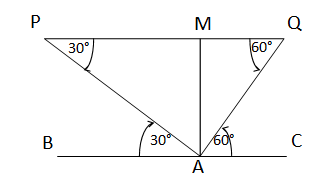
Let’s assume Mohit is standing at point A on the field, and he observes the bird first at point P and then 2 minutes later at point Q. Since the bird is flying at a constant height, the path PQ is parallel to the ground BC. From point A, the height of the bird is AM = \(50\sqrt{3}\) meters. Now, ∠APM = alternate angle ∠BAP = 30° and ∠AQM = alternate angle ∠QAC = 60° [Because PQ || BC] From right-angled triangle APM: \[ \tan 30^\circ = \frac{AM}{PM} = \frac{50\sqrt{3}}{PM} \Rightarrow \frac{1}{\sqrt{3}} = \frac{50\sqrt{3}}{PM} \Rightarrow PM = 150 \] From right-angled triangle AMQ: \[ \tan 60^\circ = \frac{AM}{MQ} \Rightarrow \sqrt{3} = \frac{50\sqrt{3}}{MQ} \Rightarrow MQ = \frac{50\sqrt{3}}{\sqrt{3}} = 50 \] ∴ Distance traveled by the bird: \[ PQ = PM + MQ = 150 + 50 = 200 \text{ meters} \] Since the bird covers 200 meters in 2 minutes, its speed per hour is: \[ \frac{200 \times 60}{2} = 6000 \text{ meters/hour} = 6 \text{ kilometers/hour} \]