1. Draw a triangle ABC such that BC = 6 cm, CA = 5.5 cm, and AB = 4.5 cm. Then draw the incircle of ∆ABC. (Only construction marks are required.)
2. Draw triangle ABC in which BC = 7 cm, AB = 5 cm, and AC = 6 cm. Then construct the incircle of the triangle. (Only the construction markings are required.)
3. Draw triangle ABC where AB = 8 cm, BC = 6 cm, and ∠ABC = 60°. Construct the circumcircle of that triangle. (Only construction marks are required).
4. Draw a triangle in which two sides are 9 cm and 7 cm, and the included angle between them is 60°. Then draw the incircle of that triangle. (Only construction marks are required.)
5. In \(\triangle ABC\), \(AB = 9\) cm, \(BC = 6\) cm, and \(CA = 7.5\) cm. In \(\triangle DEF\), the corresponding side to \(BC\) is \(EF\), and \(EF = 8\) cm. Given that \(\triangle ABC \sim \triangle DEF\), determine the perimeter of \(\triangle DEF\).
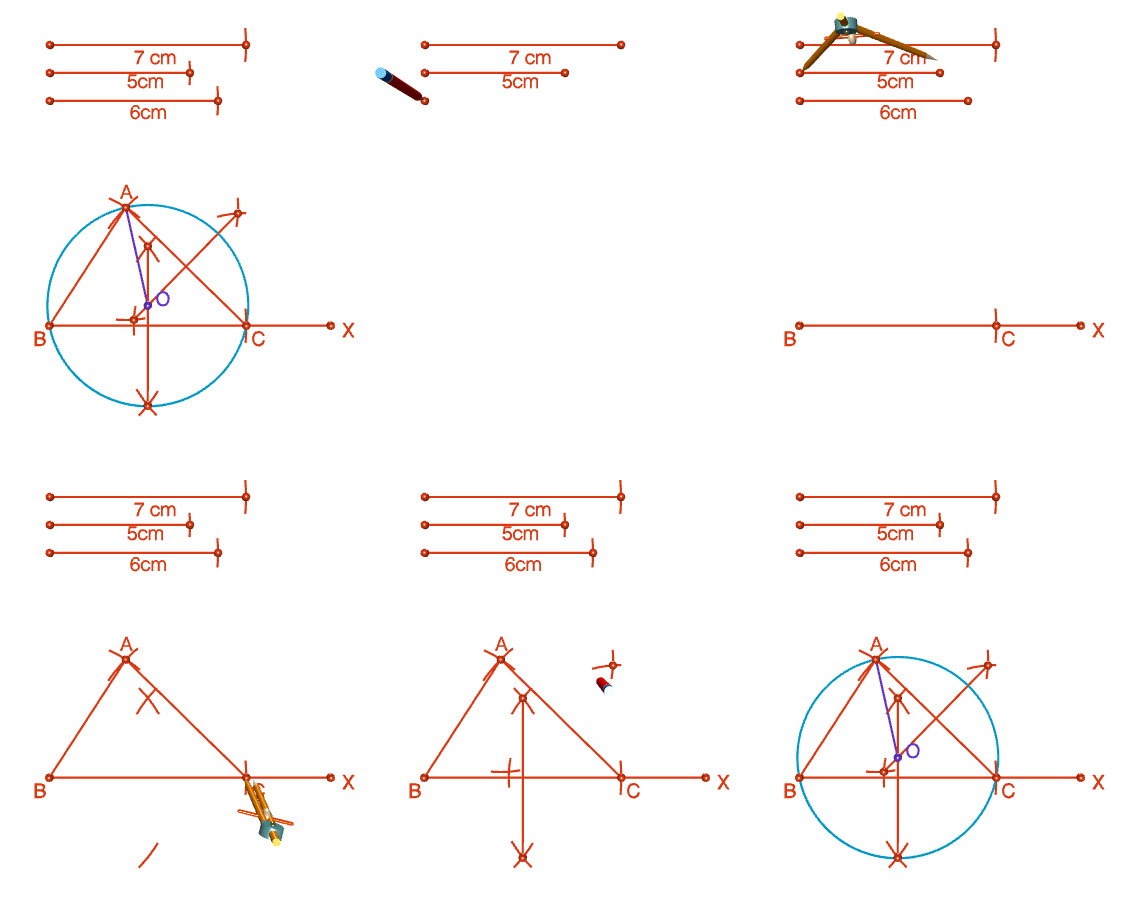
6. Draw a triangle with side lengths of 5 cm, 6 cm, and 7 cm. Then, draw the incircle of that triangle (only construction marks should be included).
7. PQ = 7.5 cm, ∠QPR = 45°, ∠PQR = 75°; PQ = 7.5 cm, ∠QPS = 60°, ∠PQS = 60°; Draw ∆PQR and ∆PQS such that points R and S lie on the same side of PQ. Draw the circumcircle of ∆PQR, and observe the position of point S with respect to this circumcircle — whether it lies inside, on, or outside the circle — and explain your reasoning.