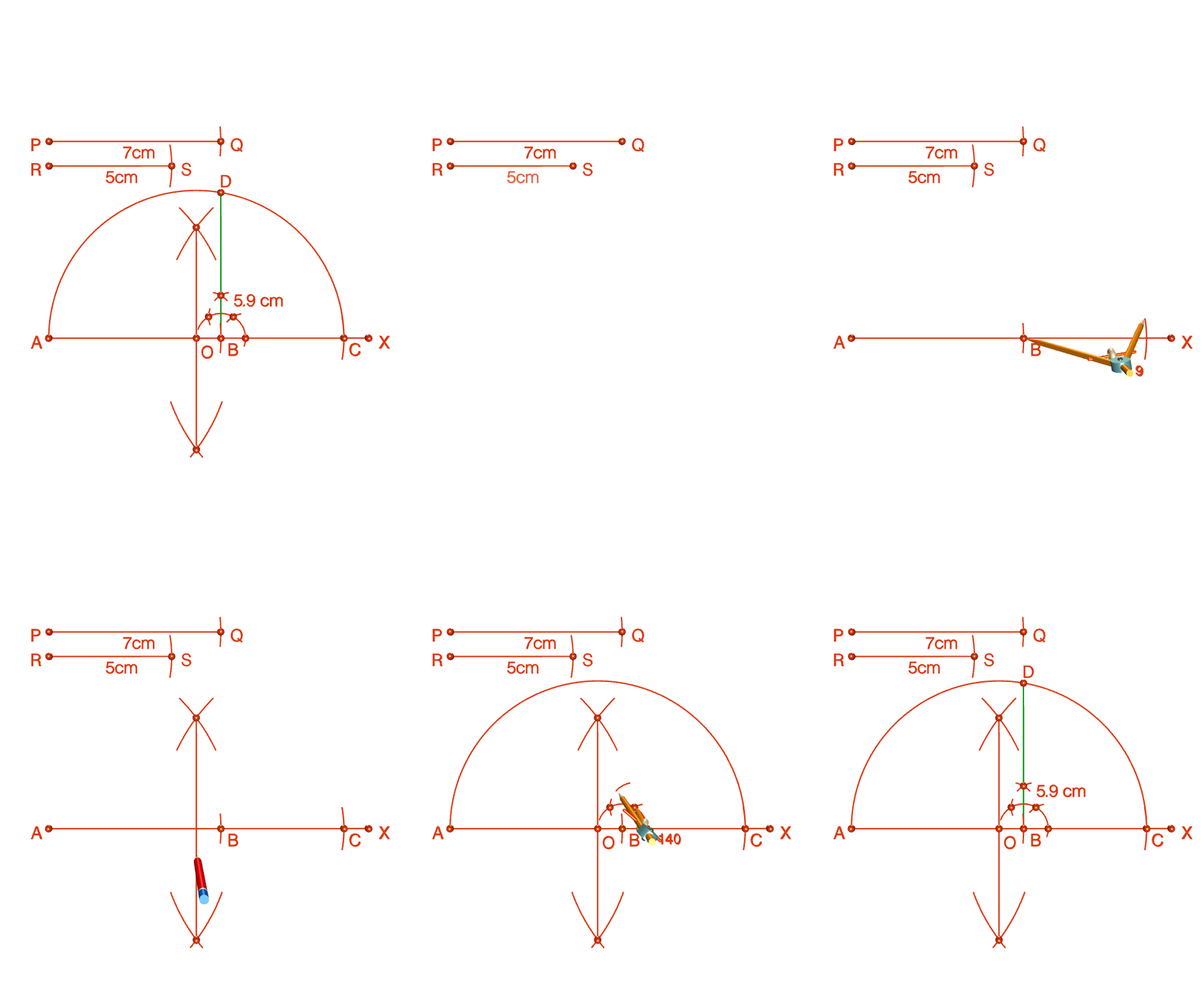
1. Determine the value of √19 using a geometric method. (Only construction marks are required.)
2. Determine the value of \(2\sqrt{7}\) using a geometric method. (Only the construction marks are required.)
3. Translate to English: "Find the value of √21 using a geometrical method. (Only construction markings are to be provided)"
4. Determine the value of √18 using geometric method. (Only provide the construction marks)
5. Determine the geometric mean between 12 cm and 3 cm using a geometric construction method. (In both cases, only construction markings are required.)
6. Find the value of \(\sqrt{21}\) using a geometric method. (Only the construction diagram needs to be provided.)
7. Determine the value of \(2\sqrt{7}\) geometrically. (Only construction marks are required)
8. Determine the value of \(\sqrt{15}\) using a geometric method. (Only provide the construction steps or diagram labels.)
9. Determine the value of \(2\sqrt{3}\) using a geometric method. (Only provide the construction diagram.)
10. Determine the value of √35 geometrically. (Only indicate the construction marks at each step.)
11. Determine the value of √35 using a geometric method.
12. Draw a right-angled triangle whose two sides adjacent to the right angle are 7 cm and 9 cm respectively. Then draw the incircle of that triangle. (Only construction marks are required.)
13. Draw a triangle in which two sides are 9 cm and 7 cm, and the included angle between them is 60°. Then draw the incircle of that triangle. (Only construction marks are required.)
14. Draw a triangle ABC such that BC = 6 cm, CA = 5.5 cm, and AB = 4.5 cm. Then draw the incircle of ∆ABC. (Only construction marks are required.)
15. Draw a rectangle with sides of 8 cm and 6 cm, and then draw a square having the same area as that rectangle. (Only construction marks are required.)
16. Draw triangle ABC such that BC = 7 cm, AB = 5 cm, and AC = 6 cm. Then draw the circumcircle of triangle ABC. (Only construction marks are required.)
17. Draw a right-angled triangle whose hypotenuse is 10 cm and one of the other sides is 6.5 cm. Then, draw the incircle of this triangle. (Only construction marks are required.)
18. Draw the incircle of an equilateral triangle with side length 10 cm. (Only construction marks are required.)
19. Draw a square having the same area as a rectangle of length 10 cm and width 5 cm. (Only construction marks are required.)
20. Draw a rectangle with a length of 7 cm and a width of 4 cm; now draw a square with the same area as that rectangle. (Only the construction marks are required.)
21. Draw a right-angled triangle whose hypotenuse is 9 cm and one of the other sides is 5.5 cm. Then draw an incircle of the triangle. (Only the construction marks are required.)
22. Find the value of \(√12\) using a geometric method.
23. Draw a right-angled triangle whose two sides adjacent to the right angle are 4.5 cm and 6 cm. Then draw the incircle of that triangle. (Only construction marks are required.)
24. Determine the value of \(\sqrt{33}\) using a geometric method.
25. Find the value of \( \sqrt{23} \) geometrically. (Only construction marks should be included.)
26. Determine the value of √23 geometrically. (Only construction marks should be used in each step.)
27. Determine the value of √21 using a geometric method (only provide the construction steps).
28. Determine the value of √21 using a geometric method.
29. Draw a right-angled triangle with the two sides adjacent to the right angle measuring 4 cm each. Then draw the circumcircle of the triangle. (Only construction marks are required.)
30. Determine the square root of 7 using geometric method.