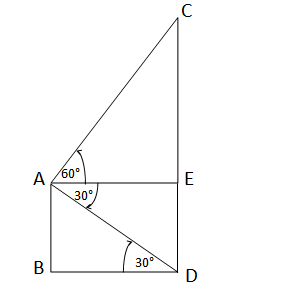
Let’s assume point A is the deck of the ship, which is 10 meters above sea level, so AB = 10 meters. From point A, Apu observes the top of the lighthouse at point C at an angle of elevation of 60°, and the base of the lighthouse at point D at an angle of depression of 30°. Let AE ∥ BD (horizontal line from A), so: ∠CAE = 60° ∠EAD = 30° ∴ ∠ADB = ∠EAD = 30° From right-angled triangle ABD: \[ \tan 30^\circ = \frac{AB}{BD} = \frac{10}{BD} \Rightarrow \frac{1}{\sqrt{3}} = \frac{10}{BD} \Rightarrow BD = 10\sqrt{3} \] ∴ The distance from the ship to the lighthouse is \(10\sqrt{3}\) meters. Since AE = BD = \(10\sqrt{3}\), From right-angled triangle AEC: \[ \tan 60^\circ = \frac{CE}{AE} = \frac{CE}{10\sqrt{3}} \Rightarrow \sqrt{3} = \frac{CE}{10\sqrt{3}} \Rightarrow CE = 30 \] Now, \[ CD = CE + ED = CE + AB = 30 + 10 = 40 \text{ meters} \] ∴ The height of the lighthouse is 40 meters.