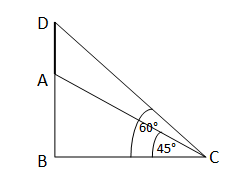
Let AB be the height of the incomplete pillar, and let point C be a location 150 meters away from its base (i.e., BC = 150 m). From point C, the angle of elevation to the top of the pillar A is ∠ACB = 45°. Suppose the pillar is extended up to point D, and now the angle of elevation to the new top D is ∠DCB = 60°. From right-angled triangle ABC: \[ \tan 45^\circ = \frac{AB}{BC} \Rightarrow 1 = \frac{AB}{150} \Rightarrow AB = 150 \text{ meters} \] From right-angled triangle DBC: \[ \tan 60^\circ = \frac{DB}{BC} \Rightarrow \sqrt{3} = \frac{DB}{150} \Rightarrow DB = 150\sqrt{3} = 150 \times 1.732 = 259.8 \text{ meters} \] Therefore, the additional height added to the pillar is: \[ AD = DB - AB = 259.8 - 150 = 109.8 \text{ meters} \] ∴ The pillar must be raised by approximately 109.8 meters.