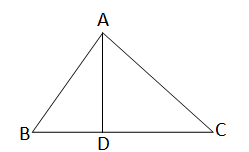
Pythagorean Theorem: In any right-angled triangle, the area of the square drawn on the hypotenuse is equal to the sum of the areas of the squares drawn on the other two sides. Given: ABC is a right-angled triangle where ∠A is the right angle. **To Prove:** \(BC^2 = AB^2 + AC^2\) Construction: From the right angle at point A, draw a perpendicular AD to the hypotenuse BC, intersecting BC at point D. Proof: In right-angled triangle ABC, AD is perpendicular to the hypotenuse BC. ∴ Triangles ∆ABD and ∆CBA are similar. So, \[ \frac{AB}{BC} = \frac{BD}{AB} \Rightarrow AB^2 = BC \cdot BD \quad \text{...(i)} \] Again, triangles ∆CAD and ∆CBA are similar. So, \[ \frac{AC}{BC} = \frac{DC}{AC} \Rightarrow AC^2 = BC \cdot DC \quad \text{...(ii)} \] Adding equations (i) and (ii): \[ AB^2 + AC^2 = BC \cdot BD + BC \cdot DC = BC(BD + DC) = BC \cdot BC = BC^2 \] ∴ \[ BC^2 = AB^2 + AC^2 \quad \text{[Proved]} \]