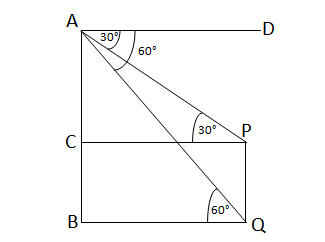
Let AB = 30\(\sqrt{3}\) meters be the height of a house. From point A on the roof, the angles of depression to the top (P) and bottom (Q) of a lamp post PQ are 30° and 60°, respectively. ∴ ∠DAP = 30° and ∠DAQ = 60° [Assume AD ∥ BQ] Draw CP ∥ BQ. Then, ∠APC = alternate angle ∠DAP = 30° ∠AQB = alternate angle ∠DAQ = 60° From right-angled triangle ∆ABQ: \(\tan 60^\circ = \cfrac{AB}{BQ}\) ⇒ \(\sqrt{3} = \cfrac{AB}{BQ}\) ⇒ \(BQ = \cfrac{AB}{\sqrt{3}} = \cfrac{30\sqrt{3}}{\sqrt{3}} = 30\) Again, from right-angled triangle ∆ACP: \(\tan 30^\circ = \cfrac{AC}{CP}\) ⇒ \(\cfrac{1}{\sqrt{3}} = \cfrac{AC}{CP}\) ⇒ \(AC = \cfrac{CP}{\sqrt{3}} = \cfrac{30}{\sqrt{3}} = 10\sqrt{3}\) ∴ Height of the lamp post \(= PQ = BC\) \(= AB - AC\) \(= (30\sqrt{3} - 10\sqrt{3})\) meters \(= 20\sqrt{3}\) meters