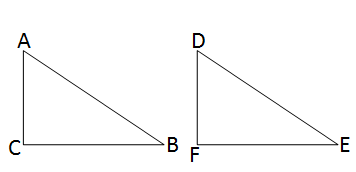
Let us assume that in triangle \( \triangle ABC \), the area of the square constructed on side AB is equal to the sum of the areas of the squares constructed on sides BC and AC. That is, \( AB^2 = AC^2 + BC^2 \) We need to prove that \( \angle ACB = 90^\circ \) ### Construction: Draw a line segment \( FE \) equal in length to \( BC \). At point \( F \), draw a perpendicular line and mark point \( D \) such that \( FD = AC \). Join points \( D \) and \( E \). ### Proof: Given: \( AB^2 = BC^2 + AC^2 \) Substituting from the construction: \( AB^2 = EF^2 + DF^2 \) [since \( EF = BC \) and \( DF = AC \)] \( = DE^2 \) [because \( \angle DFE = 90^\circ \), by construction] \(\therefore AB = DE\) Now, in triangles \( \triangle ABC \) and \( \triangle DEF \): AB = DE, BC = EF, and AC = DF \(\therefore \triangle ABC \cong \triangle DEF\) [by SSS congruence rule] \(\therefore \angle ACB = \angle DEF = 90^\circ\) [since \( DF \perp EF \) by construction] \(\therefore \angle ACB = 90^\circ\) Hence proved.