Answer: C
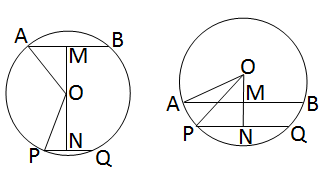
Let’s assume AB = 16 cm and PQ = 12 cm are two parallel chords of a circle with center O. OA = OP = radius of the circle = 10 cm MN = perpendicular distance between the two chords From right-angled triangle MOA, OM² = OA² − AM² = 10² − \((\frac{16}{2})^2\) = 100 − 64 = 36 \(\therefore\) OM = \(\sqrt{36}\) cm = 6 cm Again, from right-angled triangle OPN, ON² = OP² − PN² = 10² − \((\frac{12}{2})^2\) = 100 − 36 = 64 \(\therefore\) ON = \(\sqrt{64}\) cm = 8 cm \(\therefore\) MN = ON + OM = (8 + 6) cm = 14 cm Or, MN = ON − OM = (8 − 6) cm = 2 cm
Let’s assume AB = 16 cm and PQ = 12 cm are two parallel chords of a circle with center O. OA = OP = radius of the circle = 10 cm MN = perpendicular distance between the two chords From right-angled triangle MOA, OM² = OA² − AM² = 10² − \((\frac{16}{2})^2\) = 100 − 64 = 36 \(\therefore\) OM = \(\sqrt{36}\) cm = 6 cm Again, from right-angled triangle OPN, ON² = OP² − PN² = 10² − \((\frac{12}{2})^2\) = 100 − 36 = 64 \(\therefore\) ON = \(\sqrt{64}\) cm = 8 cm \(\therefore\) MN = ON + OM = (8 + 6) cm = 14 cm Or, MN = ON − OM = (8 − 6) cm = 2 cm