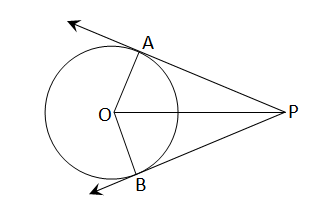
Given: From an external point \(P\), two tangents \(PA\) and \(PB\) are drawn to a circle with center \(O\), where \(A\) and \(B\) are the points of contact. Lines \(OA\), \(OB\), and \(OP\) are joined, forming angles ∠POA and ∠POB at the center. To Prove: (i) \(PA = PB\) (ii) ∠POA = ∠POB Proof: Since \(PA\) and \(PB\) are tangents, and \(OA\) and \(OB\) are radii drawn to the points of contact, ∴ \(OA \perp PA\) and \(OB \perp PB\) In right-angled triangles \(POA\) and \(POB\): - ∠OAP = ∠OBP (each is a right angle) - Hypotenuse \(OP\) is common - \(OA = OB\) (radii of the same circle) ∴ ∆PAO ≅ ∆PBO [By RHS congruence criterion] ∴ \(PA = PB\) (corresponding sides of congruent triangles) — (i) Proven And ∠POA = ∠POB (corresponding angles of congruent triangles) — (ii) Proven