Answer: D
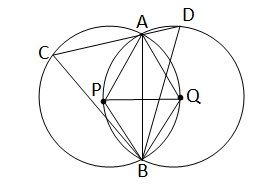
Given Let P and Q be the centers of two circles with equal radii. Each circle passes through the center of the other, and they intersect at points A and B. A straight line through point A intersects the two circles again at points C and D respectively. **Construction:** Join A, B; P, Q; A to P; B to P; A to Q; B to Q. **Proof:** In ∆APQ, AP = PQ = AQ [radii of the circles] ∴ ∆APQ is an equilateral triangle ∴ ∠APQ = ∠AQP = ∠PAQ = 60° In ∆BPQ, BP = PQ = BQ [radii of the circles] ∴ ∠BPQ = ∠BQP = ∠PBQ = 60° ∴ ∠APQ + ∠BPQ = ∠AQP + ∠BQP = 60° + 60° ∴ ∠APB = ∠AQB = 120° Point C lies on arc AQB of the circle centered at P ∴ ∠ACB = ½ × ∠APB = ½ × 120° = 60° Point D lies on arc APB of the circle centered at Q ∴ ∠ADB = ½ × ∠AQB = ½ × 120° = 60° In ∆BCD, remaining ∠CBD = 60° ∴ ∆BCD is an equilateral triangle
Given Let P and Q be the centers of two circles with equal radii. Each circle passes through the center of the other, and they intersect at points A and B. A straight line through point A intersects the two circles again at points C and D respectively. **Construction:** Join A, B; P, Q; A to P; B to P; A to Q; B to Q. **Proof:** In ∆APQ, AP = PQ = AQ [radii of the circles] ∴ ∆APQ is an equilateral triangle ∴ ∠APQ = ∠AQP = ∠PAQ = 60° In ∆BPQ, BP = PQ = BQ [radii of the circles] ∴ ∠BPQ = ∠BQP = ∠PBQ = 60° ∴ ∠APQ + ∠BPQ = ∠AQP + ∠BQP = 60° + 60° ∴ ∠APB = ∠AQB = 120° Point C lies on arc AQB of the circle centered at P ∴ ∠ACB = ½ × ∠APB = ½ × 120° = 60° Point D lies on arc APB of the circle centered at Q ∴ ∠ADB = ½ × ∠AQB = ½ × 120° = 60° In ∆BCD, remaining ∠CBD = 60° ∴ ∆BCD is an equilateral triangle