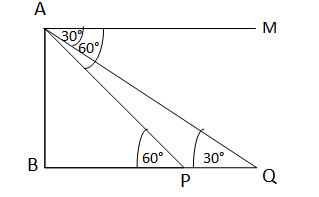
Let’s assume that when the airplane was at point A, it observed two consecutive kilometer markers P and Q on the road at angles of depression of 60° and 30°, respectively. The airplane was flying at a height of AB meters. Assume that AM || BQ ∴ ∠MAP = 60° and ∠MAQ = 30° ∠APB = alternate angle of ∠MAP = 60° ∠AQB = alternate angle of ∠MAQ = 30° [∵ AM || BQ] From the right-angled triangle APB: \[ \tan 60^\circ = \frac{AB}{PB} \Rightarrow \sqrt{3} = \frac{AB}{PB} \Rightarrow PB = \frac{AB}{\sqrt{3}} \quad \text{(i)} \] From the right-angled triangle ABQ: \[ \tan 30^\circ = \frac{AB}{BQ} \Rightarrow \frac{1}{\sqrt{3}} = \frac{AB}{BQ} \Rightarrow BQ = AB \cdot \sqrt{3} \quad \text{(ii)} \] Given: \[ PQ = 1 \text{ kilometer} = 1000 \text{ meters} \] Now, \[ PQ = BQ - PB \Rightarrow 1000 = AB\sqrt{3} - \frac{AB}{\sqrt{3}} \quad \text{[from (i) and (ii)]} \] \[ \Rightarrow AB\left(\sqrt{3} - \frac{1}{\sqrt{3}}\right) = 1000 \Rightarrow AB \cdot \frac{3 - 1}{\sqrt{3}} = 1000 \Rightarrow AB = \frac{1000 \cdot \sqrt{3}}{2} = 500\sqrt{3} \] ∴ When the two markers are on the same side, the height of the airplane is \(500\sqrt{3}\) meters.