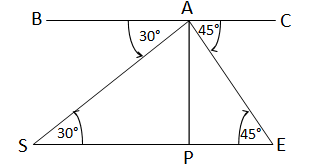
Let the person be standing at point A on the railway overbridge BC. He observes the engine of the train first at point S and then, after 2 seconds, at point E. The angles of depression are ∠BAS = 30° and ∠CAE = 45° Height of the overbridge, AP = 5√3 meters Since BC || SE, ∠ASP = alternate angle of ∠BAS = 30° ∠AEP = alternate angle of ∠CAE = 45° From right-angled triangle ASP: tan 30° = \(\cfrac{AP}{SP} = \cfrac{5√3}{SP}\) i.e., \(\cfrac{1}{√3} = \cfrac{5√3}{SP}\) i.e., \(SP = 15\) meters From right-angled triangle APE: tan 45° = \(\cfrac{AP}{PE} = \cfrac{5√3}{PE}\) i.e., \(1 = \cfrac{5√3}{PE}\) i.e., \(PE = 5√3\) meters ∴ Distance covered by the train in 2 seconds = SE = SP + PE = 15 + 5√3 = 15 + (5 × 1.732) = 15 + 8.660 = 23.660 meters ∴ Speed of the train = \(\cfrac{23.660}{2}\) meters/second = 11.83 meters/second (approx.)