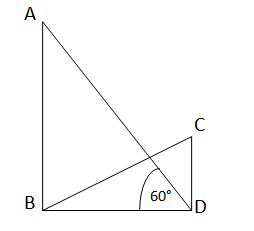
Let us assume two pillars AB = 45 meters and CD = 15 meters. From the base of the second pillar (point D), the angle of elevation to the top of the first pillar (point A) is ∠ADB = 60°. We are required to find the angle of elevation from the base of the first pillar (point B) to the top of the second pillar (point C), i.e., ∠CBD. Let ∠CBD = θ. From right-angled triangle ABD: \(\tan 60^\circ = \cfrac{AB}{BD}\) Or, \(\sqrt{3} = \cfrac{AB}{BD}\) Or, \(BD = \cfrac{AB}{\sqrt{3}}\) Or, \(BD = \cfrac{45}{\sqrt{3}} = \cfrac{45 \times \sqrt{3}}{3} = 15\sqrt{3}\) Now, from right-angled triangle CBD: \(\tan ∠CBD = \cfrac{CD}{BD}\) Or, \(\tan θ = \cfrac{15}{15\sqrt{3}}\) Or, \(\tan θ = \cfrac{1}{\sqrt{3}}\) Or, \(\tan θ = \tan 30^\circ\) Therefore, \(θ = 30^\circ\) ∴ The angle of elevation from the base of the first pillar to the top of the second pillar is \(30^\circ\).