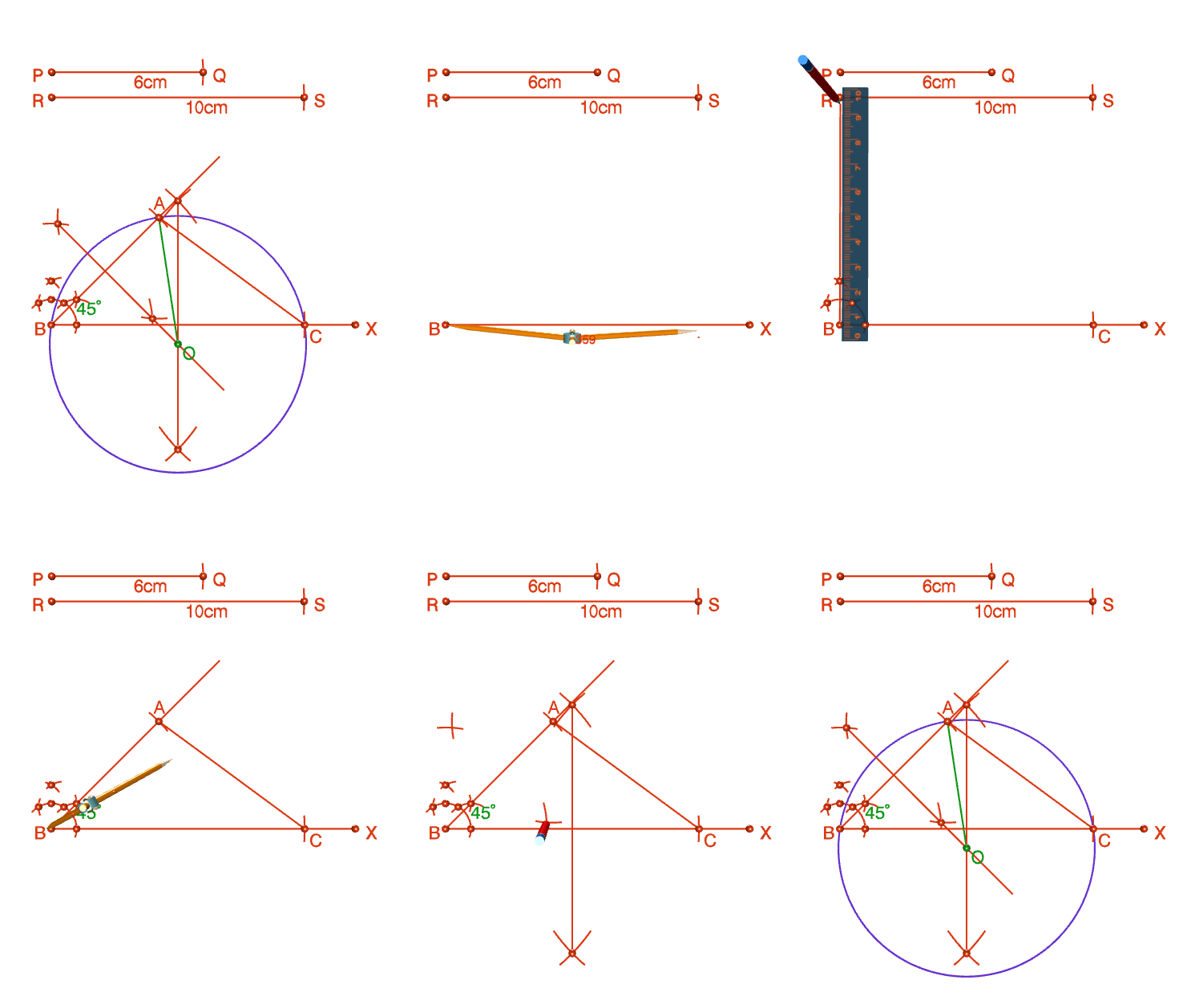
1. Draw triangle ABC where AB = 8 cm, BC = 6 cm, and ∠ABC = 60°. Construct the circumcircle of that triangle. (Only construction marks are required).
2. Triangle ABC where the base BC = 5 cm, ∠ABC = 100°, and AB = 4 cm. — Draw the triangle and then draw its circumcircle. Mark the position of the circumcenter and measure and write the length of the circumradius (i.e., the radius of the circumcircle). [Only drawing symbols required]
3. Draw triangle ABC such that BC = 7 cm, AB = 5 cm, and AC = 6 cm. Then draw the circumcircle of triangle ABC. (Only construction marks are required.)
4. Draw triangle ABC in which BC = 7 cm, AB = 5 cm, and AC = 6 cm. Then construct the incircle of the triangle. (Only the construction markings are required.)
5. Draw a triangle ABC such that BC = 6 cm, CA = 5.5 cm, and AB = 4.5 cm. Then draw the incircle of ∆ABC. (Only construction marks are required.)
6. In a circle with center O, AB and CD are two equal chords. If \(\angle\)AOB = 60° and CD = 10 cm, then what is the length of OD?
7. In \(\triangle\)ABC, \(\angle\)ABC = 90° and BD \(\perp\) AC. If BD = 6 cm and AD = 4 cm, then find the length of CD.
8. In \(\triangle\)ABC, \(\angle\)ABC = 90° and BD \(\bot\) AC; if AB = 6 cm, BD = 3 cm, and CD = 5.4 cm, then calculate the length of side BC.
9. In \(\triangle\)ABC, \(\angle\)ABC = 90°, and BD \(\bot\) AC. If BD = 6 cm and AD = 4 cm, then what is the length of CD?
10. In triangle ABC, DE || BC, where D and E lie on sides AB and AC respectively. If AD = 5 cm, DB = 6 cm, and AE = 7.5 cm, then find the length of AC.
11. Draw a quadrilateral ABCD where AB = 4 cm, BC = 7 cm, CD = 4 cm, ∠ABC = 60°, and ∠BCD = 60°; Draw the circumcircle of ∆ABC and observe and describe its key properties.
12. Given that \(\triangle ABC\) has \(\angle ABC = 90^\circ\) and \(BD \perp AC\); if \(BD = 6\) cm and \(AD = 4\) cm, then calculate and write the length of \(CD\).
13. In \(\triangle ABC\), \(\angle ABC = 90^\circ\) and \(BD \perp AC\); if \(AB = 6\) cm, \(BD = 3\) cm, and \(CD = 5.4\) cm, then calculate and write the length of side \(BC\).
14. I have drawn a right-angled triangle ABC in which the hypotenuse AB = 10 cm, the base BC = 8 cm, and the perpendicular AC = 6 cm. Find the sine and tangent values of angle ∠ABC.
15. ABC is a right-angled triangle with \(\angle B\) being the right angle and BD ⟂ AC. If AD = 4 cm and CD = 16 cm, then calculate and write the lengths of BD and AB.
16. In triangle ABC, ∠ABC = 90° and BD ⊥ AC; If BD = 16 cm and AD = 10 cm, then find the length of CD.
17. In triangle \(ABC\) and triangle \(DEF\), \(\angle ABC = \angle DEF\), \(\frac{AB}{DE} = \frac{BC}{EF}\), and the ratio of their areas is \(\frac{\triangle ABC}{\triangle DEF} = \frac{25}{16}\). If \(BC = 10\) cm, what is the length of \(EF\)?
18. In triangle ABC, \(\angle\)BAC = 90°, and AD is perpendicular to BC. Given: AC = 8 cm, AB = 6 cm Find: The length of BD.
(a) 6 cm (b) 1.5 cm (c) 3 cm (d) 3.6 cm
19. In triangle ABC, \(\angle\)ABC is a right angle, and AB = 5 cm, BC = 12 cm. What is the radius of the circumcircle of triangle ABC?
20. In triangle ABC, ∠A is a right angle. From point A, a line is drawn to point D, the midpoint of the hypotenuse BC. If BC = 10 cm, then the length of AD is —
(a) 5 cm (b) 6 cm (c) 7 cm (d) 8 cm
21. In right-angled triangle ABC, \(\angle B = 90^\circ\), and M is the midpoint of the hypotenuse drawn from point B. If AB = 6 and AC = 8, then what is the length of BM?
(a) 10 (b) 4 (c) 16 (d) None of the above
22. In triangle △ABC, if ∠ABC = 90°, AB = 5 cm, and BC = 12 cm, then what is the radius of its circumcircle?
23. In triangle ABC, \(\angle ABC = 90^\circ\), and AB = 6 cm, BC = 8 cm. Find the circumradius of triangle ABC.
24. AB is a chord of a circle with center O. From point O, a perpendicular OP is drawn to the chord AB. The extended line OP intersects the circle at point C. If AB = 6 cm and PC = 1 cm, then what is the radius of the circle?
25. ABC is a right-angled triangle with hypotenuse BC. From point A, a perpendicular AD is drawn to BC. If BD = 4 cm and DC = 5 cm, then what is the length of AB?
26. In the figure, triangle ABC is inscribed in a circle and touches the circle at points P, Q, and R. If AP = 4 cm, BP = 6 cm, AC = 12 cm, and BC = x cm, then what is the value of x?
27. In a circle centered at \(O\), two chords \(AB\) and \(CD\) have equal lengths. Given that \(\angle AOB = 60°\) and the radius of the circle is \(6\) cm, find the area of \(\triangle COD\).
(a) \(9\sqrt3\) square c.m (b) \(6\sqrt3\) square c.m (c) \(2\sqrt3\) square c.m (d) \(3\sqrt3\) square c.m
28. In a circle centered at \(O\), two equal chords \(AB\) and \(CD\) are given. If \(\angle AOB = 60^\circ\) and the radius of the circle is 6 cm, determine the area of \( \triangle COD \).
(a) \(6\sqrt3\) square cm (b) \(2\sqrt3\) square cm (c) \(2\sqrt3\) square cm (d) \(9\sqrt3\) square cm
29. In \(\triangle\)ABC, \(\angle B = 90°\) and \(BD \perp AC\). If \(AB = 6\) cm, \(BD = 3\) cm, and \(CD = 5.4\) cm, find the length of \(BC\).
30. In \(\triangle\)ABC, if AB = \((2a-1)\) cm, AC = \(2\sqrt{2}a\) cm, and BC = \((2a+1)\) cm, then write the value of \(\angle\)BAC.