1. Draw a triangle with side lengths of 4.5 cm, 5.5 cm, and 6 cm. Draw the incircle of that triangle.
2. Draw a triangle in which two sides are 9 cm and 7 cm, and the included angle between them is 60°. Then draw the incircle of that triangle. (Only construction marks are required.)
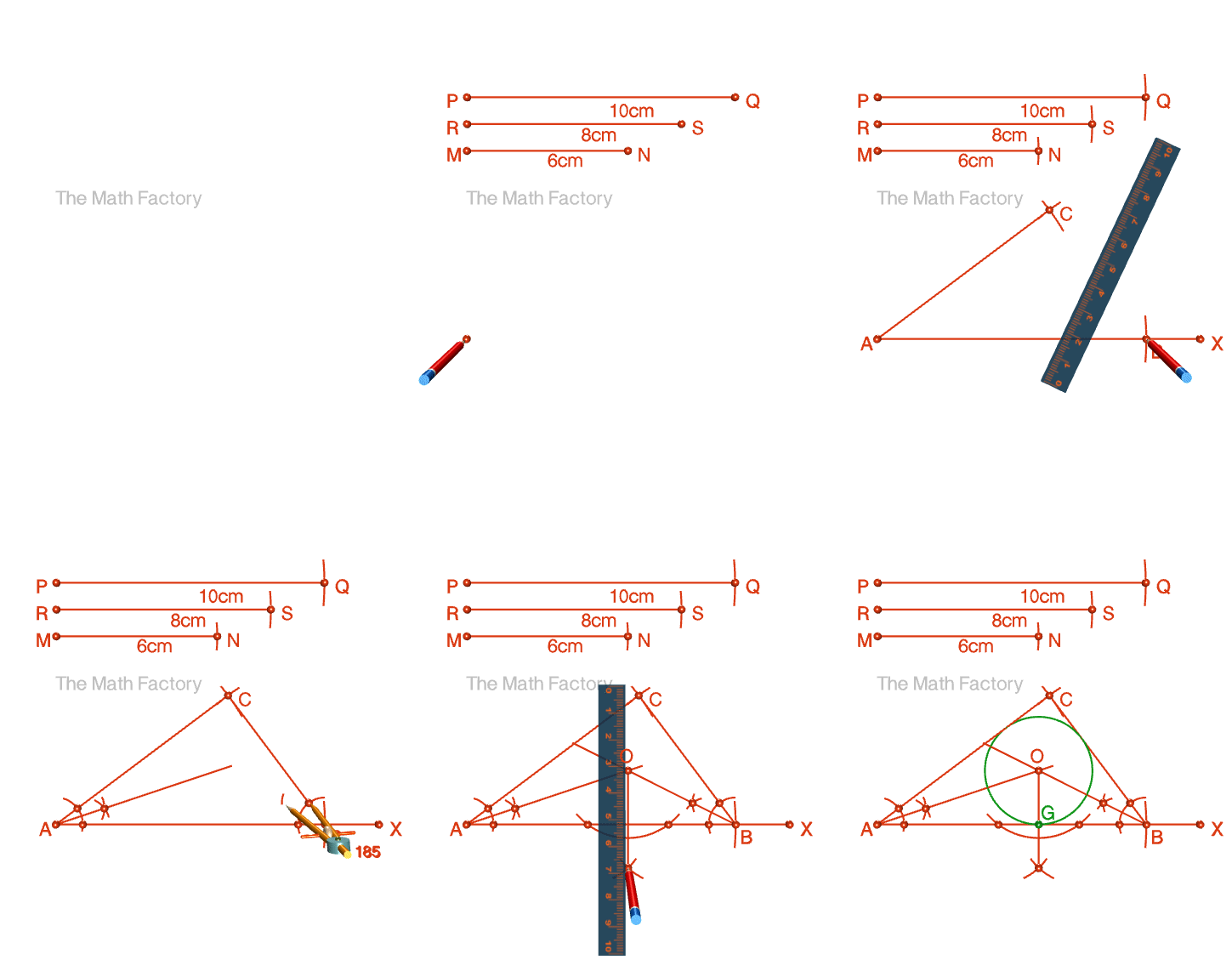
3. Draw a triangle with three sides measuring 7 cm, 6 cm, and 5.5 cm. Then, draw an incircle for that triangle.
4. Draw a triangle with side lengths of 5 cm, 6 cm, and 7 cm. Then, draw the incircle of that triangle (only construction marks should be included).
5. Draw a triangle with two sides measuring 6.5 cm and 5.7 cm, and the included angle. Then, draw the incircle of the triangle.
6. Draw an isosceles triangle whose base is 7.8 cm and the length of each of the equal sides is 6.5 cm. Then draw an incircle (an inscribed circle) inside that triangle.
7. If a triangle similar to one with sides 4 cm, 6 cm, and 8 cm has its largest side measuring 6 cm, what is the length of the smallest side of that triangle?
(a) 4 cm (b) 3 cm (c) 2 cm (d) 5 cm
8. Draw a triangle ABC such that BC = 6 cm, CA = 5.5 cm, and AB = 4.5 cm. Then draw the incircle of ∆ABC. (Only construction marks are required.)
9. Draw a rectangle with sides of 8 cm and 6 cm, and then draw a square having the same area as that rectangle. (Only construction marks are required.)
10. Draw a right-angled triangle whose hypotenuse is 10 cm and one of the other sides is 6.5 cm. Then, draw the incircle of this triangle. (Only construction marks are required.)
11. Draw a triangle whose sides are 7 cm, 6 cm, and 5.5 cm respectively. Draw the incircle of the triangle. (Only provide the diagram)
12. Draw a right-angled triangle whose two sides adjacent to the right angle are 4.5 cm and 6 cm. Then draw the incircle of that triangle. (Only construction marks are required.)
13. Draw a triangle with two sides measuring 7.6 cm and 6 cm, and an included angle of 75\(^o\). Then, construct its incircle.
14. Draw a triangle with side lengths of 7 cm, 6 cm, and 5.5 cm. Draw the incircle of the triangle and measure the radius of the incircle.
15. Draw triangle ABC where AB = 8 cm, BC = 6 cm, and ∠ABC = 60°. Construct the circumcircle of that triangle. (Only construction marks are required).
16. I have drawn a right-angled triangle ABC in which the hypotenuse AB = 10 cm, the base BC = 8 cm, and the perpendicular AC = 6 cm. Find the sine and tangent values of angle ∠ABC.
17. Draw a triangle whose two sides are 7 cm and 6 cm, and the included angle is 75°. Then draw the incircle of the triangle.
18. Draw triangle ABC in which BC = 7 cm, AB = 5 cm, and AC = 6 cm. Then construct the incircle of the triangle. (Only the construction markings are required.)
19. The three sides of a triangle are 6 cm, 8 cm, and 10 cm respectively. What is the circumradius of the triangle? This triangle is special—it’s a right triangle (since \(6^2 + 8^2 = 36 + 64 = 100 = 10^2\)). And for right triangles, the circumradius is half the hypotenuse. So the circumradius = \(\frac{10}{2} = 5\) cm.
20. Draw an isosceles triangle with a base of 6.5 cm and two equal sides of 7 cm each. Then, draw the incircle of that triangle.
21. Draw triangle ABC such that BC = 7 cm, AB = 5 cm, and AC = 6 cm. Then draw the circumcircle of triangle ABC. (Only construction marks are required.)
22. Draw a triangle ABC where AB = 6 cm, BC = 10 cm, and \(\angle ABC = 45^\circ\); then draw the circumcircle of the triangle.
23. Draw a right-angled triangle whose two sides adjacent to the right angle are 8 cm and 6 cm respectively, and draw an incircle of the triangle. (Only construction marks are required)
24. Point P is an external point to a circle with center O. The distance from point P to the center of the circle is 26 cm, and the length of the tangent drawn from point P to the circle is 10 cm. The radius of the circle is ____ cm.
25. In \(\triangle ABC\), the center of the incircle is \(O\), and the incircle touches the sides \(AB\), \(BC\), and \(CA\) at points \(P\), \(Q\), and \(R\) respectively. Given that \(AP = 4\) cm, \(BP = 6\) cm, \(AC = 12\) cm, and \(BC = x\) cm, determine the value of \(x\).
26. In \(\triangle ABC\), \(AB = 9\) cm, \(BC = 6\) cm, and \(CA = 7.5\) cm. In \(\triangle DEF\), the corresponding side to \(BC\) is \(EF\), and \(EF = 8\) cm. Given that \(\triangle ABC \sim \triangle DEF\), determine the perimeter of \(\triangle DEF\).
27. Draw an isosceles triangle where the base length is 5 cm and each of the equal sides is 6 cm. Then, draw the incircle of the triangle. (Only construction marks should be indicated in each case.)
28. AB = 5 cm, ∠BAC = 30°, ∠ABC = 60°; AB = 5 cm, ∠BAD = 45°, ∠ABD = 45°; Draw ∆ABC and ∆ABD in such a way that points C and D lie on opposite sides of AB. Draw the circumcircle of ∆ABC and write the position of point D with respect to that circle. Also, observe and describe any other noteworthy properties.
29. The lengths of two sides are 7.6 cm and 6 cm, and the included angle between them is 75°. — Draw the triangle and then draw its incircle. Measure and write the length of the inradius (i.e., the radius of the incircle).
30. The length of one side is 6.2 cm, and the measures of the two angles adjacent to that side are 50° and 75°. — Draw the triangle and then draw its incircle. Measure and write the length of the inradius (i.e., the radius of the incircle).