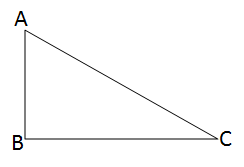
1. In triangle △ABC, if ∠ABC = 90°, AB = 5 cm, and BC = 12 cm, then what is the radius of its circumcircle?
2. The three sides of a triangle are 6 cm, 8 cm, and 10 cm respectively. What is the circumradius of the triangle? This triangle is special—it’s a right triangle (since \(6^2 + 8^2 = 36 + 64 = 100 = 10^2\)). And for right triangles, the circumradius is half the hypotenuse. So the circumradius = \(\frac{10}{2} = 5\) cm.
3. In a right-angled triangle, the two acute angles are \(\theta\) and \(\phi\). If \( \tan\theta = \cfrac{5}{12} \), then what is the value of \( \sin\phi \)?
(a) \(\cfrac{12}{13}\) (b) \(\cfrac{5}{13}\) (c) \(\cfrac{1}{4}\) (d) \(\cfrac{10}{13}\)
4. In triangle ABC, ∠A = 90°, AB = 12 cm, AC = 5 cm, and BC = 13 cm. A perpendicular AD is drawn from point A to side BC. What is the length of AD?
5. A right-angled triangle where the hypotenuse is 12 cm and one of the other sides is 5 cm. — Draw the triangle and then draw its circumcircle. Mark the position of the circumcenter and measure and write the radius of the circumcircle. [Only drawing symbols required]
6. In isosceles triangle ABC, the circumcenter is O and \(\angle ABC = 120^\circ\). If the radius of the circle is 5 cm, find the length of side AB.
7. In triangle △ABC, ∠ABC = 90° and BD ⊥ AC. If AB = 5 cm and BC = 12 cm, then what is the length of BD?
8. ABC is a right-angled triangle with hypotenuse BC. From point A, a perpendicular AD is drawn to BC. If BD = 4 cm and DC = 5 cm, then what is the length of AB?
9. In a circle with a radius of 5 cm, AB and AC are two equal chords. The center of the circle is located outside the triangle ABC. If AB = AC = 6 cm, determine the length of the chord BC.
10. In \(\triangle ABC\), \(AB = 9\) cm, \(BC = 6\) cm, and \(CA = 7.5\) cm. In \(\triangle DEF\), the corresponding side to \(BC\) is \(EF\), and \(EF = 8\) cm. Given that \(\triangle ABC \sim \triangle DEF\), determine the perimeter of \(\triangle DEF\).
11. In a right-angled triangle, the hypotenuse is 15 cm, and the difference between the other two sides is 3 cm. Find the lengths of those two sides.
12. Triangle ABC where the base BC = 5 cm, ∠ABC = 100°, and AB = 4 cm. — Draw the triangle and then draw its circumcircle. Mark the position of the circumcenter and measure and write the length of the circumradius (i.e., the radius of the circumcircle). [Only drawing symbols required]
13. “In triangle PQR, where ∠Q is a right angle, PR = √5 units and the difference between PQ and RQ is 1 unit. Find the value of cos∠P − cos∠R.”
14. Draw an equilateral triangle ABC with each side measuring 5 cm. Then, draw the circumcircle of that triangle. At point A on the circle, draw a tangent. On the tangent, take a point P such that AP = 5 cm. From point P, draw another tangent to the circle, and write down which point on the circle this second tangent touches.
15. In a right-angled triangle, if the ratio of the perpendicular (opposite side) to the hypotenuse with respect to a positive acute angle \(\theta\) is \(12 : 13\), then determine the ratio of the perpendicular to the base and the ratio of the hypotenuse to the base, and verify that \( \sec^2\theta = 1 + \tan^2\theta \).
16. In triangle \(\triangle ABC\), AB = AC. Points E and F are the midpoints of sides AB and AC respectively. AD is perpendicular to BC, and AD = 4 cm. If EF = 3 cm, then what is the length of BD?
(a) 4 cm (b) 3 cm (c) 6 cm (d) 7 cm
17. In triangle ABC, the incenter is I. When the internal bisector of ∠A (i.e., AI) is extended, it intersects the circumcircle at point P. If PB = 15 cm, then what is the length of PI?
(a) 5 cm (b) 15 cm (c) 10 cm (d) 20 cm
18. ABC and POR are two similar triangles. If BC = 5 cm, QR = 4 cm, and the height AD = 3 cm, then what is the length of the height PE?
(a) 4.2 cm (b) 1.25 cm (c) 5.4 cm (d) 2.4 cm
19. Draw triangle ABC such that BC = 7 cm, AB = 5 cm, and AC = 6 cm. Then draw the circumcircle of triangle ABC. (Only construction marks are required.)
20. In right-angled triangle ABC, ∠ABC = 90°, AB = 3 cm, BC = 4 cm, and from point B, a perpendicular BD is drawn to side AC, meeting AC at point D. Find the length of BD.
21. In triangle \(\triangle ABC\), the incircle touches the sides AB, BC, and CA at points D, E, and F respectively. Given: AD = 12 cm, BE = 5 cm, and CF = 4 cm. Find the lengths of AB, BC, and CA.
22. A wooden box with a lid is made using wood that is 0.5 cm thick. The external dimensions of the box are: length = 20 cm, width = 16 cm, and height = 12 cm. What is the volume of the wood used to make the box?
(a) 800 cubic centimeters (b) 790 cubic centimeters (c) 820 cubic centimeters (d) 850 cubic centimeters
23. In the figure, triangle ABC is inscribed in a circle and touches the circle at points P, Q, and R. If AP = 4 cm, BP = 6 cm, AC = 12 cm, and BC = x cm, then what is the value of x?
24. In a circle centered at \(O\), two chords \(AB\) and \(CD\) have equal lengths. Given that \(\angle AOB = 60°\) and the radius of the circle is \(6\) cm, find the area of \(\triangle COD\).
(a) \(9\sqrt3\) square c.m (b) \(6\sqrt3\) square c.m (c) \(2\sqrt3\) square c.m (d) \(3\sqrt3\) square c.m
25. Draw an isosceles triangle with a base length of 5.2 cm and each of the equal sides measuring 7 cm. Then, construct the circumcircle of the triangle and measure the circumradius. (Only mark the construction steps).
26. In a circle centered at \(O\), two equal chords \(AB\) and \(CD\) are given. If \(\angle AOB = 60^\circ\) and the radius of the circle is 6 cm, determine the area of \( \triangle COD \).
(a) \(6\sqrt3\) square cm (b) \(2\sqrt3\) square cm (c) \(2\sqrt3\) square cm (d) \(9\sqrt3\) square cm
27. In \(\triangle ABC\), the center of the incircle is \(O\), and the incircle touches the sides \(AB\), \(BC\), and \(CA\) at points \(P\), \(Q\), and \(R\) respectively. Given that \(AP = 4\) cm, \(BP = 6\) cm, \(AC = 12\) cm, and \(BC = x\) cm, determine the value of \(x\).
28. A right-angled triangle in which the hypotenuse is 9 cm and one of the other sides is 5.5 cm. — Draw the triangle and then draw its incircle. Measure and write the length of the inradius (i.e., the radius of the incircle).
29. In right-angled triangle ABC, ∠B is the right angle. If AB = \(8\sqrt{3}\) cm and BC = 8 cm, then calculate the values of ∠ACB and ∠BAC.
30. In triangle RST, ∠S is a right angle. Let X and Y be the midpoints of sides RS and ST respectively. Prove that: RY² + XT² = 5XY²