1. Draw the incircle of an isosceles triangle whose base is 5.2 cm and each of the equal sides is 7 cm long.
2. Draw an isosceles triangle with a base length of 5.2 cm and each of the equal sides measuring 7 cm. Then, construct the circumcircle of the triangle and measure the circumradius. (Only mark the construction steps).
3. Draw an isosceles triangle where the base length is 5 cm and each of the equal sides is 6 cm. Then, draw the incircle of the triangle. (Only construction marks should be indicated in each case.)
4. Draw an isosceles triangle in which each of the equal sides is 7 cm and the base is 8 cm long. Then, draw an incircle of that triangle.
5. Draw an isosceles triangle whose base is 7.8 cm and the length of each of the equal sides is 6.5 cm. Then draw an incircle (an inscribed circle) inside that triangle.
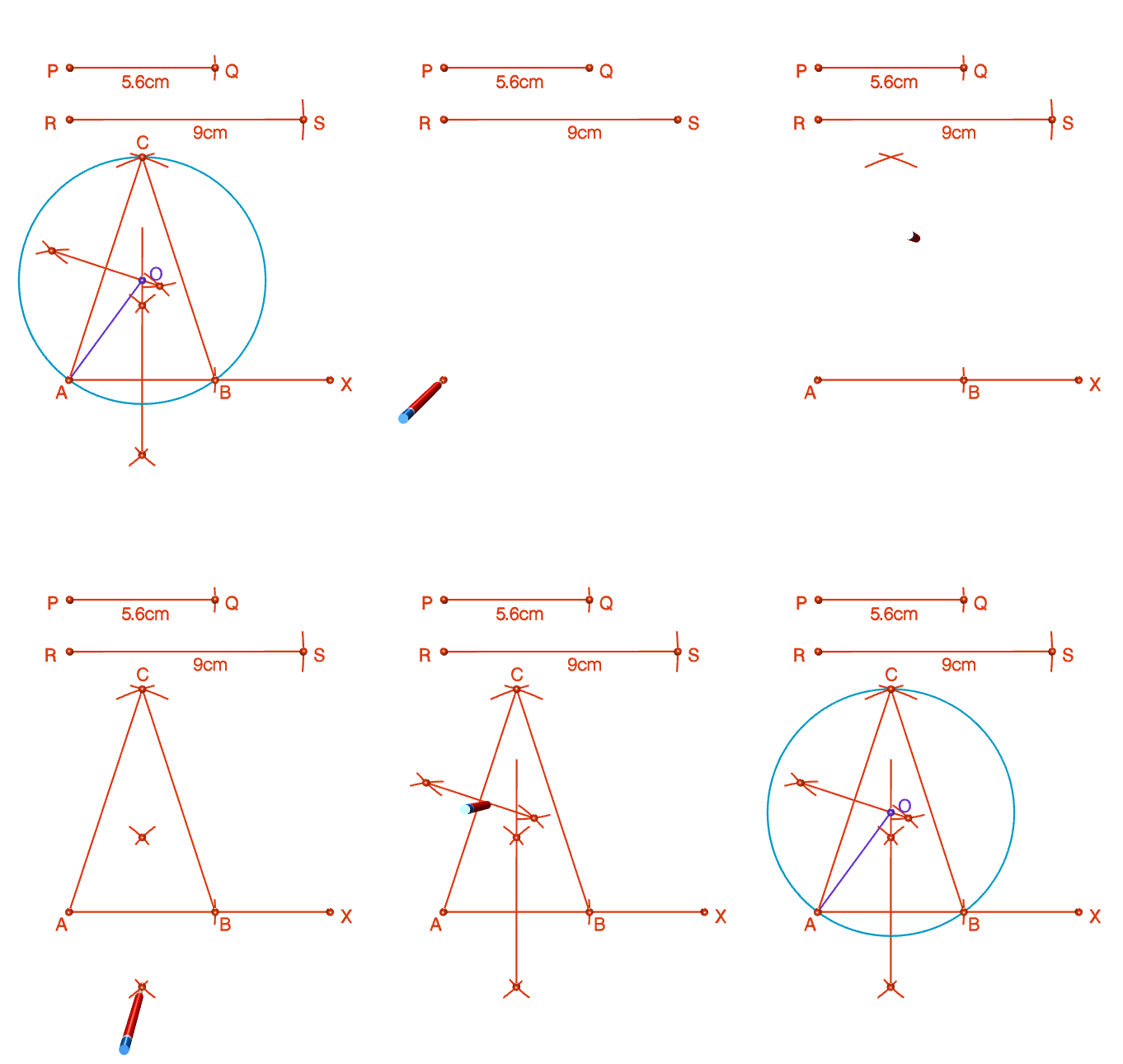
6. Here is the drawing of an isosceles triangle with a base length of 5.6 cm and equal sides of 7.5 cm each, along with its incircle.
7. Draw a square with the same area as an isosceles triangle whose base length is 7 cm and each of the equal sides is 5 cm.
8. Draw an isosceles triangle with a base of 6.5 cm and two equal sides of 7 cm each. Then, draw the incircle of that triangle.
9. Draw a right-angled triangle whose hypotenuse is 10 cm and one of the other sides is 6.5 cm. Then, draw the incircle of this triangle. (Only construction marks are required.)
10. Draw a right-angled triangle whose hypotenuse is 9 cm and one of the other sides is 5.5 cm. Then draw an incircle of the triangle. (Only the construction marks are required.)
11. An isosceles triangle where the base is 7.8 cm and each of the equal sides is 6.5 cm. — Draw the triangle and then draw its incircle. Measure and write the length of the inradius (i.e., the radius of the incircle).
12. Draw a right-angled isosceles triangle where each of the equal sides is 6 cm long. Then, draw the incircle of the triangle.
13. What is the radius of the circumcircle of a triangle whose sides are 20 cm, 21 cm, and 29 cm?
(a) 14\(\frac{1}{2}\) cm (b) 14 cm (c) 10 cm (d) 11\(\frac{1}{2}\) cm
14. Draw a triangle in which two sides are 9 cm and 7 cm, and the included angle between them is 60°. Then draw the incircle of that triangle. (Only construction marks are required.)
15. The lengths of the two equal sides of an isosceles triangle are 5 cm, and the base is 6 cm. The area of the triangle is —
(a) 18 square cm (b) 12 square cm (c) 15 square cm (d) 30 square cm
16. Draw an isosceles triangle with a base length of 10 cm and an equal angle of 45°. Draw the incircle of the triangle and write the value of the inradius. (Only marking for construction should be included.)
17. Draw an equilateral triangle ABC with each side measuring 5 cm. Then, draw the circumcircle of that triangle. At point A on the circle, draw a tangent. On the tangent, take a point P such that AP = 5 cm. From point P, draw another tangent to the circle, and write down which point on the circle this second tangent touches.
18. ABC is an isosceles triangle with a base of 10 cm and each of the equal angles measuring 45°. Draw the triangle and its incircle.
19. Draw an isosceles triangle with a base length of 10 cm and one of the equal angles measuring 45°. Then, draw the incircle of the triangle.
20. Draw a right-angled triangle whose two sides adjacent to the right angle are 7 cm and 9 cm respectively. Then draw the incircle of that triangle. (Only construction marks are required.)
21. Given: In triangle △ABC, O is the circumcenter and OD ⊥ BC. Prove that: ∠BOD = ∠BAC Let’s break it down in English: **Given:** In triangle △ABC, O is the circumcenter (the point where the perpendicular bisectors of the sides meet), and OD is perpendicular to side BC. **To Prove:** The angle ∠BOD formed at the center between points B and D is equal to the angle ∠BAC at the vertex A. This is a classic geometry result based on the properties of a circle and triangle. Would you like me to walk you through the full proof in English as well?
22. An isosceles triangle where the length of the base is 10 cm and one of the equal angles measures 45°.
23. If each of the equal sides of a right-angled isosceles triangle is \(4\sqrt{2}\) cm, then the length of the hypotenuse is ___________ cm.
24. Draw a triangle whose two sides are 7 cm and 6 cm, and the included angle is 75°. Then draw the incircle of the triangle.
25. A hemispherical vessel with an inner radius of 9 cm is completely filled with water. This water is poured into cylindrical bottles, each having a diameter of 3 cm and a height of 4 cm. How many such bottles are required to hold all the water?
26. In triangle △ABC, if ∠ABC = 90°, AB = 5 cm, and BC = 12 cm, then what is the radius of its circumcircle?
27. A hollow iron cylinder of height 20 cm has an outer radius of 5 cm and an inner radius of 4 cm. This cylinder is melted and recast into a solid cone whose height is one-third of the original cylinder's height. Find the diameter of the base of the cone.
28. In a right-angled triangle, the hypotenuse is 6 cm longer than one of the other two sides and 12 cm longer than the other. Find the area of the triangle.
29. Perfectly explained. The triangle formed is a right-angled isosceles triangle, where the angle of elevation is 45°, making the opposite and adjacent sides equal. So, the height of the pillar equals the distance from its base: 20 meters.
(a) 1:2:3 (b) 1:5:7 (c) 1:7:9 (d) None of the above
30. Draw a right-angled triangle whose two sides adjacent to the right angle are 8 cm and 6 cm respectively, and draw an incircle of the triangle. (Only construction marks are required)