Answer: A
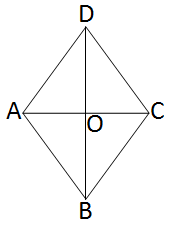
Let ABCD be a rhombus with each side measuring 17 cm, and one of its diagonals AC = 16 cm. Also, the diagonals of a rhombus bisect each other at right angles. So, OA = \(\frac{1}{2}\) × AC = 8 cm From triangle △AOD, we get: OD² = AD² − OA² = 17² − 8² = 289 − 64 = 225 ∴ OD = \(\sqrt{225}\) = 15 cm ∴ BD = 2 × OD = 2 × 15 cm = 30 cm.
Let ABCD be a rhombus with each side measuring 17 cm, and one of its diagonals AC = 16 cm. Also, the diagonals of a rhombus bisect each other at right angles. So, OA = \(\frac{1}{2}\) × AC = 8 cm From triangle △AOD, we get: OD² = AD² − OA² = 17² − 8² = 289 − 64 = 225 ∴ OD = \(\sqrt{225}\) = 15 cm ∴ BD = 2 × OD = 2 × 15 cm = 30 cm.