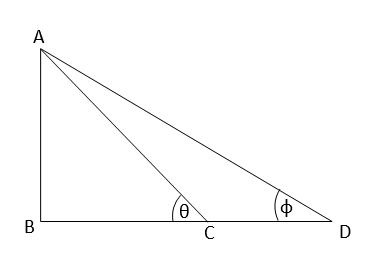
Here's the English translation of your geometry problem: Let us assume: \(AB = h\) is the height of a vertical pillar, and on the same side and along the same horizontal line through the base point \(B\), there are two points \(C\) and \(D\). From these points, the angles of elevation to the top point \(A\) of the pillar are \(\angle ACB = \theta\) and \(\angle ADB = \phi\), respectively. We need to find the distance between the two points, i.e., \(CD\). From triangle \(ABC\): \[ \frac{AB}{BC} = \tan \theta \Rightarrow \frac{h}{BC} = \tan \theta \Rightarrow BC = \frac{h}{\tan \theta} \] Again, from triangle \(ABD\): \[ \frac{AB}{BD} = \tan \phi \Rightarrow \frac{h}{BD} = \tan \phi \Rightarrow BD = \frac{h}{\tan \phi} \] Now, \[ CD = BD - BC = \frac{h}{\tan \phi} - \frac{h}{\tan \theta} = \frac{h \tan \theta - h \tan \phi}{\tan \theta \tan \phi} \] ∴ The distance between the two points is \[ \frac{h \tan \theta - h \tan \phi}{\tan \theta \tan \phi} \]