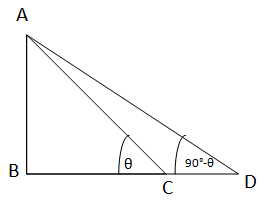
Let AB be the vertical pillar, and points C and D lie on the same straight line on the ground with the base B of the pillar. From points C and D, the angles of elevation to the top of the pillar A are ∠ACB and ∠ADB, which are complementary. Given: BC = 9 meters and BD = 16 meters. Let ∠ACB = \(\theta\) Then, ∠ADB = \(90^\circ - \theta\) From triangle ABC: \[ \tan \theta = \frac{AB}{BC} = \frac{AB}{9} \quad \text{(i)} \] From triangle ABD: \[ \tan(90^\circ - \theta) = \frac{AB}{BD} \Rightarrow \cot \theta = \frac{AB}{16} \Rightarrow \tan \theta = \frac{16}{AB} \quad \text{(ii)} \] Equating equations (i) and (ii): \[ \frac{AB}{9} = \frac{16}{AB} \Rightarrow AB^2 = 144 \Rightarrow AB = \sqrt{144} = 12 \] Therefore, the height of the pillar is 12 meters.