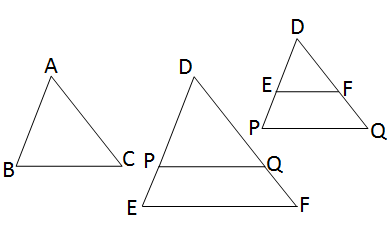
Let ABC and DEF be two similar triangles. That is, \(\angle A = \angle D\), \(\angle B = \angle E\), and \(\angle C = \angle F\) We need to prove that: \[ \frac{AB}{DE} = \frac{BC}{EF} = \frac{AC}{DF} \] **Construction:** From triangle DEF, mark off segments DP and DQ on extended DE and DF respectively, such that DP = AB and DQ = AC. Join points P and Q. **Proof:** In triangles ABC and DPQ: AB = DP, \(\angle A = \angle D\), and AC = DQ \(\therefore \triangle ABC \cong \triangle DPQ\) [By SAS congruence] \(\therefore \angle B = \angle P\) Also, \(\angle B = \angle P\) [Given] \(\therefore \angle P = \angle E\) So, PQ ∥ EF [Because corresponding angles are equal] \(\therefore \frac{DP}{DE} = \frac{DQ}{DF}\) [By Thales' Theorem] \(\therefore \frac{AB}{DE} = \frac{AC}{DF} \quad \text{(i)}\) [Since DP = AB and DQ = AC] Similarly, by marking off segments equal to BA and BC on extended ED and EF, we can prove: \(\frac{AB}{DE} = \frac{BC}{EF} \quad \text{(ii)}\) From equations (i) and (ii), we get: \[ \frac{AB}{DE} = \frac{BC}{EF} = \frac{AC}{DF} \quad \text{(Proved)} \]