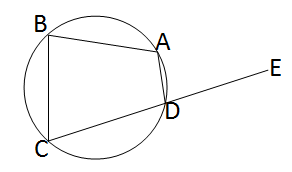
1. In the cyclic quadrilateral ABCD, side AB is extended up to point P. If ∠CAB = 35° and ∠CBP = 82°, then what is the measure of ∠ADB?
(a) 47° (b) 55° (c) 35° (d) 60°
2. In the cyclic quadrilateral ABCD, side AB is extended up to point X. If \(\angle\)XBC = 82° and \(\angle\)ADB = 47°, then what is the measure of \(\angle\)BAC?
(a) 45° (b) 45° (c) 35° (d) 60°
3. ABCD is a cyclic quadrilateral. The side BA is extended up to point F. AE is drawn parallel to CD, and ∠ABC = 92°, ∠FAE = 20°. Find the measure of ∠BCD.
4. AB is extended to point X in the cyclic quadrilateral ABCD. If \(\angle\)XBC = 98° and \(\angle\)ADB = 45°, then what is the measure of \(\angle\)BAC?
5. PQRS is a cyclic quadrilateral in which side QR is extended up to point T. If the measures of angles ∠SRQ and ∠SRT are in the ratio 4:5, then find the measures of ∠SPQ and ∠SRQ.
6. In the cyclic quadrilateral ABCD, side AB is extended to point X. If ∠XBC = 82° and ∠ADB = 47°, then find the measure of ∠BAC.
7. ABCD is a cyclic quadrilateral. The sides AB and DC are extended to meet at point P, and the sides AD and BC are extended to meet at point Q. If ∠ADC = 85° and ∠BPC = 40°, then find the measures of ∠BAD and ∠CQD.
8. ABCD is a cyclic quadrilateral with O as the center of the circle. Side DC is extended up to point P. If \(\angle BCP = 108^\circ\), calculate and write the measure of \(\angle BOD\).
9. ABCD is a cyclic quadrilateral. The side AB is extended up to point X, and it is measured that ∠XBC = 82° and ∠ADB = 47°; calculate and write the value of ∠BAC.
10. PQRS is a cyclic quadrilateral, and the sides PQ and SR are extended to meet at point T. The center of the circle is O; if ∠POQ = 110°, ∠QOR = 60°, and ∠ROS = 80°, then calculate and write the values of ∠RQS and ∠QTR.
11. In the adjacent figure, ABCD is a cyclic quadrilateral. BA is extended to point F. AE ∥ CD, ∠ABC = 92°, and ∠FAE = 20°. Find the measure of ∠BCD.
(a) 20° (b) 88° (c) 108° (d) 72°
12. In triangle \( \triangle ABC \), AC = BC and side BC is extended up to point D. If \( \angle ACD = 144^\circ \), then find the radian measure of each angle of triangle ABC.
13. Two tangents are drawn to a circle from points A and B on the circumference, and they intersect at point C. Another point P lies on the circumference, on the side opposite to where point C is located with respect to the center. If \(\angle\)APB = 35°, then what is the measure of \(\angle\)ACB?
(a) 145° (b) 55° (c) 110° (d) None of the above
14. AB is a chord of a circle centered at O, and PT is a tangent to the circle at point A. If ∠ AOB = 120°, then what is the measure of ∠ BAT?
(a) 60° (b) 30° (c) 90° (d) 45°
15. AB is a chord of a circle with center O. From point O, a perpendicular OP is drawn to the chord AB. The extended line OP intersects the circle at point C. If AB = 6 cm and PC = 1 cm, then what is the radius of the circle?
16. In the adjacent figure, O is the center of the circle and BOA is the diameter. A tangent is drawn at point P on the circle, which intersects the extended line BA at point T. If \(\angle PBO = 30^\circ\), then what is the measure of \(\angle PTA\)?
17. ABCD is a cyclic trapezium in which sides AD and BC are parallel to each other. If \(\angle\)ABC = 75°, then what is the measure of \(\angle\)BCD?
(a) 105° (b) 90° (c) 150° (d) 75°
18. Two tangents are drawn to a circle from points A and B on its circumference, and they intersect at point P. If \(\angle\)APB = 68°, then what is the measure of \(\angle\)PAB?
19. ABCD is a cyclic quadrilateral. The sides AD and AB are extended to E and F, respectively. If \(\angle\) CBF = 120°, then find the measure of \(\angle\) CDE.
20. In the cyclic quadrilateral ABCD, the side \( AB \) is extended to point \( X \), forming \( \angle XBC = 82^\circ \) and \( \angle ADB = 47^\circ \). Find the measure of \( \angle BAC \).
21. In the cyclic quadrilateral ABCD, side BC is extended up to point E. If \(\angle BAD = 140^\circ\), then find the value of \(\angle DCE\).
(a) 75° (b) 90° (c) 140° (d) None of the above
22. From an external point \(P\), two tangents \(PS\) and \(PT\) are drawn to a circle with center \(O\). \(QS\) is a chord of the circle that is parallel to \(PT\). If \(\angle SPT = 80^\circ\), then what is the measure of \(\angle QST\)?
23. A straight line parallel to side BC of \(\triangle\)ABC intersects AB and AC at points P and Q, respectively. If AQ = 2AP, then what is the ratio PB:QC?
(a) 1:2 (b) 2:1 (c) 1:1 (d) None of these
24. In triangle \( \triangle ABC \), a line parallel to side BC intersects sides AB and AC at points P and Q respectively. If \( AB = 3 \times PB \) and \( BC = 18 \) cm, then what is the length of \( PQ \)?
(a) 10 cm (b) 9 cm (c) 12 cm (d) 8 cm
25. In the cyclic quadrilateral ABCD, if AB = AD, \(\angle\)DAC = 70° and \(\angle\)BDC = 50°, then what is the measure of \(\angle\)ACD?
(a) 30\(^o\) (b) 40\(^o\) (c) 50\(^o\) (d) 70\(^o\)
26. In triangle \(\triangle ABC\), AB = AC. Points E and F are the midpoints of sides AB and AC respectively. AD is perpendicular to BC, and AD = 4 cm. If EF = 3 cm, then what is the length of BD?
(a) 4 cm (b) 3 cm (c) 6 cm (d) 7 cm
27. In triangle ABC, the circumcenter is O; points A and B, C lie on opposite sides of the center. If \(\angle BOC = 120^\circ\), then what is the measure of \(\angle BAC\)?
(a) 50° (b) 60° (c) 70° (d) 80°
28. AB and AC are two tangents drawn from point A to a circle with center O. The line OA intersects the chord BC (which joins the points of contact) at point M. If AM = 8 cm and BC = 12 cm, then what is the length of each tangent?
(a) 8 cm (b) 10 cm (c) 12 cm (d) 16 cm
29. In triangle ABC, the incenter is I. When the internal bisector of ∠A (i.e., AI) is extended, it intersects the circumcircle at point P. If PB = 15 cm, then what is the length of PI?
(a) 5 cm (b) 15 cm (c) 10 cm (d) 20 cm
30. O is the center of a circle. PQ is a diameter, and R is a point on the circumference. If \(\angle\)PQR = 40°, then what is the measure of \(\angle\)POR?
(a) 80° (b) 40° (c) 20° (d) 100°