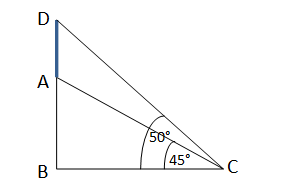
Let AB be the height of a three-storey building, and a flagpole AD of length 3.6 meters is mounted on the roof at point A. From a point C on the street, the angles of elevation to the top (point D) and bottom (point A) of the flagpole are ∠BCD = 50° and ∠BCA = 45°, respectively. From the right-angled triangle △ABC: \[ \frac{AB}{BC} = \tan 45^\circ = 1 \Rightarrow AB = BC \quad \text{(i)} \] From the right-angled triangle △BDC: \[ \frac{BD}{BC} = \tan 50^\circ = 1.2 \Rightarrow BD = 1.2BC \quad \text{(ii)} \] Since the height of the flagpole is the difference between BD and AB: \[ BD - AB = AD \Rightarrow 1.2BC - BC = 3.6 \quad \text{[Using (i) and (ii)]} \Rightarrow 0.2BC = 3.6 \Rightarrow BC = \frac{3.6}{0.2} = \frac{36}{2} = 18 \] Substituting BC into equation (i): \[ AB = BC = 18 \text{ meters} \] ∴ The height of the building is 18 meters.