Answer: D
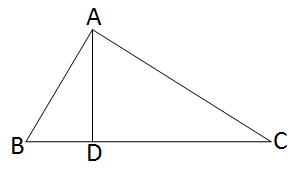
Let BD = \(x\) cm. ∴ DC = \((20 - x)\) cm. Now, triangles ABD and CAD are similar. ∴ \(\cfrac{AD}{BD} = \cfrac{CD}{AD}\) i.e., \(BD \times CD = AD^2\) ⇒ \(x(20 - x) = 8^2\) ⇒ \(20x - x^2 - 64 = 0\) ⇒ \(x^2 - 20x + 64 = 0\) ⇒ \((x - 16)(x - 4) = 0\) ⇒ \(x = 16, 4\) ∴ CD = 16 cm [because CD > BD]
Let BD = \(x\) cm. ∴ DC = \((20 - x)\) cm. Now, triangles ABD and CAD are similar. ∴ \(\cfrac{AD}{BD} = \cfrac{CD}{AD}\) i.e., \(BD \times CD = AD^2\) ⇒ \(x(20 - x) = 8^2\) ⇒ \(20x - x^2 - 64 = 0\) ⇒ \(x^2 - 20x + 64 = 0\) ⇒ \((x - 16)(x - 4) = 0\) ⇒ \(x = 16, 4\) ∴ CD = 16 cm [because CD > BD]