1. In the adjacent figure, point O is located inside triangle PQR such that ∠POR = 90°, OP = 6 cm and OR = 8 cm. If PR = 24 cm and ∠QPR = 90°, then write the length of side QR.
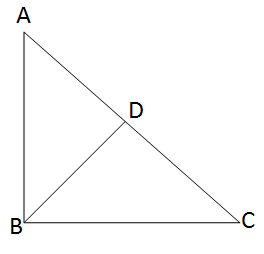
2. In \(\triangle\)ABC, \(\angle\)ABC = 90° and BD \(\perp\) AC. If BD = 6 cm and AD = 4 cm, then find the length of CD.
3. In \(\triangle\)ABC, \(\angle\)ABC = 90° and BD \(\bot\) AC; if AB = 6 cm, BD = 3 cm, and CD = 5.4 cm, then calculate the length of side BC.
4. In \(\triangle\)ABC, \(\angle B = 90°\) and \(BD \perp AC\). If \(AB = 6\) cm, \(BD = 3\) cm, and \(CD = 5.4\) cm, find the length of \(BC\).
5. In \(\triangle\)ABC, \(\angle\)ABC = 90°, and BD \(\bot\) AC. If BD = 6 cm and AD = 4 cm, then what is the length of CD?
6. Draw a rectangle PQRS where PQ = 4 cm and QR = 6 cm. Draw the two diagonals of the rectangle. Without drawing, calculate and write the position of the circumcenter of ∆PQR and the length of its circumradius. Then, draw the circumcircle of ∆PQR to verify.
7. In triangle ABC, \(\angle\)A = 90° and AD ⊥ BC, AC = 15 cm, AB = 20 cm, BC = 25 cm. Find the length of AD.
8. In triangle ABC, ∠B = 90° and BD ⊥ AC; If AB = 30 cm, BD = 24 cm, and AD = 18 cm, then what is the length of BC?
9. In triangle ABC, ∠ABC = 90° and BD ⊥ AC; If BD = 16 cm and AD = 10 cm, then find the length of CD.
10. In the center circle O, AB is a diameter. C is any point on the circumference of the circle where AC = 3 cm and BC = 4 cm. Find the length of AB.
(a) 3 cm (b) 4 cm (c) 5 cm (d) 7 cm
11. On triangle \( \triangle ABC \), points P and Q are such that \( \angle ABC = \angle APQ \). Given that \( AP = 3.6 \) cm, \( QC = 1.6 \) cm, and \( AQ = 4.8 \) cm, find the length of \( PB \).
(a) 1.2 cm (b) 2.4 cm (c) 6 cm (d) None of the above
12. In triangle ABC, \(\angle\)BAC = 90°, and AD is perpendicular to BC. Given: AC = 8 cm, AB = 6 cm Find: The length of BD.
(a) 6 cm (b) 1.5 cm (c) 3 cm (d) 3.6 cm
13. In triangle \(\triangle ABC\), AB = AC. Points E and F are the midpoints of sides AB and AC respectively. AD is perpendicular to BC, and AD = 4 cm. If EF = 3 cm, then what is the length of BD?
(a) 4 cm (b) 3 cm (c) 6 cm (d) 7 cm
14. Point O lies inside the rectangle ABCD such that OB = 6 cm, OD = 8 cm, and OA = 5 cm. Find the length of OC.
15. In triangle ABC, ∠A = 90°, AB = 12 cm, AC = 5 cm, and BC = 13 cm. A perpendicular AD is drawn from point A to side BC. What is the length of AD?
16. Draw a triangle ABC such that BC = 6 cm, CA = 5.5 cm, and AB = 4.5 cm. Then draw the incircle of ∆ABC. (Only construction marks are required.)
17. In trapezium ABCD, BC \(\parallel\) AD and AD = 4 cm. The diagonals AC and BD intersect at point O in such a way that \(\frac{AO}{OC} = \frac{DO}{OB} = \frac{1}{2}\). Find the length of BC.
18. In triangle △ABC, ∠ABC = 90° and BD ⊥ AC. If AB = 5 cm and BC = 12 cm, then what is the length of BD?
19. In right-angled triangle ABC, ∠ABC = 90°, AB = 3 cm, BC = 4 cm, and from point B, a perpendicular BD is drawn to side AC, meeting AC at point D. Find the length of BD.
20. In triangle \(\triangle ABC\), the incircle touches the sides AB, BC, and CA at points D, E, and F respectively. Given: AD = 12 cm, BE = 5 cm, and CF = 4 cm. Find the lengths of AB, BC, and CA.
21. A wooden box with a lid is made using wood that is 0.5 cm thick. The external dimensions of the box are: length = 20 cm, width = 16 cm, and height = 12 cm. What is the volume of the wood used to make the box?
(a) 800 cubic centimeters (b) 790 cubic centimeters (c) 820 cubic centimeters (d) 850 cubic centimeters
22. In triangle PQR, \(\angle\)PQR = 90° and PR = 10 cm. If S is the midpoint of side PR, then the length of QS is?
(a) 4 cm (b) 5 cm (c) 6 cm (d) 3 cm
23. In rhombus ABCD, the length of side AB is 4 cm and \(\angle\)ABC = 60°. The length of diagonal AC will be:
24. In rhombus ABCD, \(\angle\)B = 60° and CD = 6 cm. What is the length of diagonal BD?
(a) 6 cm (b) 3\(\sqrt{6}\) cm (c) 6\(\sqrt{3}\) cm (d) 3 cm
25. In triangle ABC, ∠ABC = 90° and BD ⊥ AC; if BD = 8 cm and AD = 5 cm, then the length of CD will be –
(a) \(\cfrac{16}{5}\) cm (b) \(\cfrac{32}{5}\) cm (c) \(\cfrac{64}{5}\) cm (d) \(\cfrac{128}{5}\) cm
26. In the trapezium ABCD, BC || AD, and AD = 4 cm. The diagonals AC and BD intersect at a point such that \(\frac{AO}{OC}=\frac{DO}{OD}\). Find the length of BC.
27. In the adjacent circle centered at O, OP ⊥ AB; if AB = 6 cm and PC = 2 cm, then calculate and write the length of the radius of the circle.
28. Triangle ABC where the base BC = 5 cm, ∠ABC = 100°, and AB = 4 cm. — Draw the triangle and then draw its circumcircle. Mark the position of the circumcenter and measure and write the length of the circumradius (i.e., the radius of the circumcircle). [Only drawing symbols required]
29. Given that \(\triangle ABC\) has \(\angle ABC = 90^\circ\) and \(BD \perp AC\); if \(BD = 6\) cm and \(AD = 4\) cm, then calculate and write the length of \(CD\).
30. In \(\triangle ABC\), \(\angle ABC = 90^\circ\) and \(BD \perp AC\); if \(AB = 6\) cm, \(BD = 3\) cm, and \(CD = 5.4\) cm, then calculate and write the length of side \(BC\).